Saturday, January 24, 2015

TM Research Archives - Cover Designs and Designers


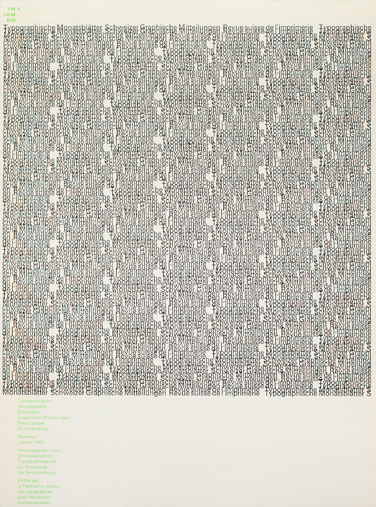
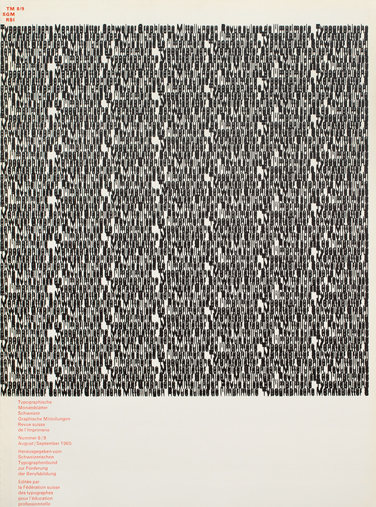
These 1965 covers were designed Hans-Rudolf Lutz, using the Univers typeface. They fascinate me because they remind me of the printed dots images that have pictures inside them if you train your eyes correctly. If you do the eye trick with these covers, all of the type become 3D. Pretty cool! Lutz, born in 1939, was a Swiss designer who was very interested in how design pertained to social interaction. He wrote and designed 9 books about visual communication. He most enjoyed educating.

---
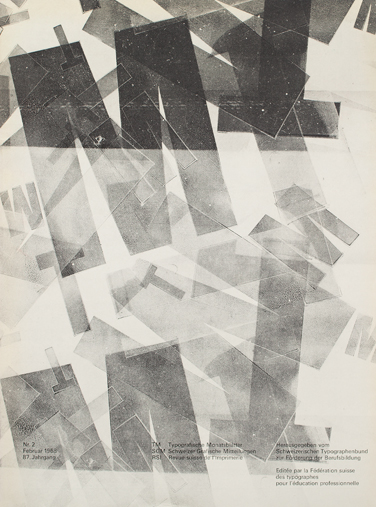

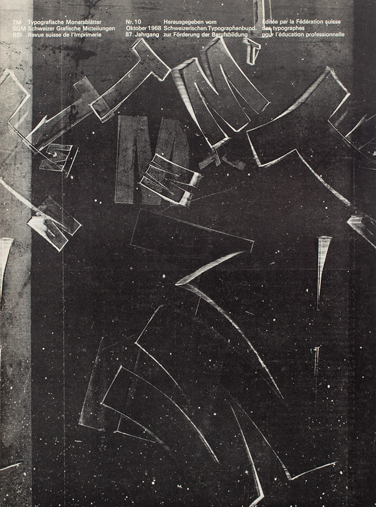
These 1968 issues were designed by Hans Ferdinand Egli from Oberwil, Switzerland. I could not find any articles about Egli in English, so unfortunately, I can't find out anything about him. These covers are made using type components from the typeface Ruder Grotesk, kerosene, and a rotative press. These images are fascinating because of three dimensional elements, depth, and simple yet complex forms.

---
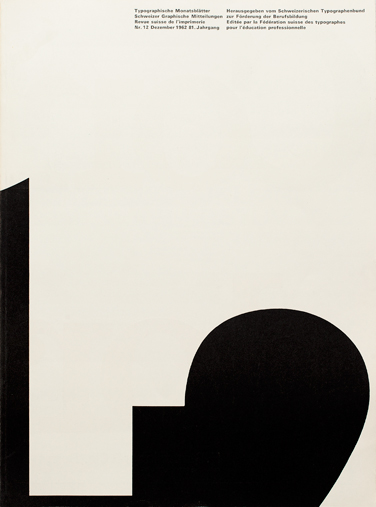

This 1962 issue was designed by André Gürtler and Bruno Pfäffli. In this design, I love the simplicity and the brilliant use of negative space used to convey the number 12. All 12 of the 1962 issues use similar techniques to display the issue number.

Gürtler, born in 1936, was a Swiss typographer and teacher, who was known as an authority in the fields of typography and design. He was an editorial collaborator for the Typographische Monatsblätter for over 20 years and also designed numerous typefaces.

Pfäffli was a Swiss typographer and designer, born in 1935, who worked for Adrian Frutiger and also did a large amount of freelance work for many international museums and institutions.

---
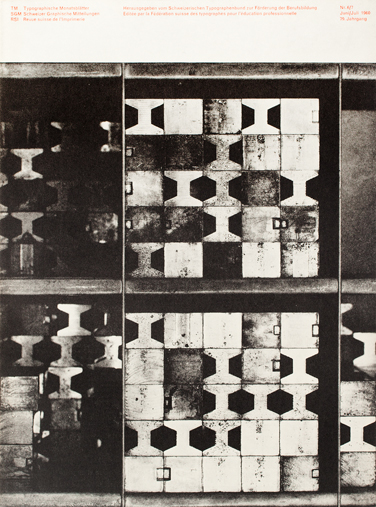

This 1960 issue was designed by Siegfried Odermatt, using a photograph by W. S. Eberle. This cover catches my eye because of the elements in the photograph, which seem to create typographic elements like the letter 'I'. Siegfried Odermatt was born in Zürich in 1926 and labeled himself a self-taught designer. He worked independently doing freelance work and won numerous awards during his career as a designer.

---
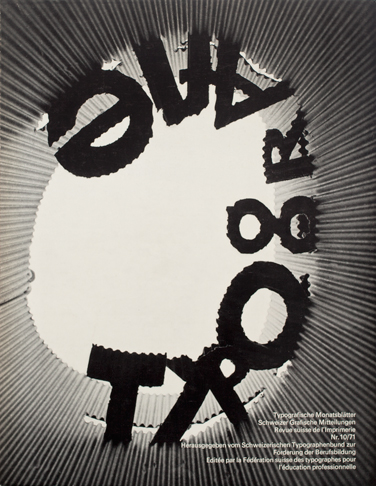

This 1971 cover was designed by Helmut Aebischer, a Swiss designerd born in 1951. He works as a typographer and a professor in the department of Visual Communication, Design, and Art at the Universität Kassel.

Wednesday, November 19, 2014

Random Type Stuff

Multicolumn grids are especially useful in formats where more flexibility is needed, instances with complex hierarchy or uses of both text and illustrations. The format becomes more and more flexible the more columns you create.

Baseline grids are used to anchor the content in a common pattern. It gives a sense of better flow and rhythm to a design.

A hang line is when a designer chooses to use a horizontal grid line from which items can "hang". This can create uniformity across a page format.

Centered text:
-Is formal and classic
-Is used to create elegant, organic shapes
-Should always utilize variance in line length

Justified text:
-Creates a clean shape on the page
-Uses space efficiently
-Can create ugly gaps between words
-Should always use a line length that is long enough to conform to the type size

Ragged text:
-Respects the organic flow of language
-Avoids uneven spaces
-Doesn't need excessive hyphenation
-Needs to be checked to prevent weird shapes forming in the ragging edge

Typographic rivers appear when coincidental line spacing lines up from one line to the next, creating ugly gaps in type running down the page. They can be especially obvious in justified text.

Type color or texture is the term used to refer to the value of a block of copy on a page. Depending on the font, the block of text may seem black or gray, or nearly colorless. This is something to take into consideration when examining page hierarchy. Reducing leading can lend a denser color while expanding leading has the opposite effect.

There are a number of ways to indicate new paragraphs. The most common way is by indenting the first line. However, adding extra space between paragraphs is cool, too. Just don't ever indent and add extra space. Also, never indent the first line of the first paragraph.

thinkingwithtype.com/

Wednesday, November 12, 2014

An Interview with Richard Misrach

Here's a great video interview with Richard Misrach about his work, his inspiration, and the ideas he hopes to convey through his photography.


Richard Misrach, Photographer

Richard Misrach is a photographer who was very influential in the 1970s and helped pioneer color and large-scale photography. He is currently the most well-known for his ongoing series, Desert Cantos, a complex photographic study of how man relates to nature. He also did a series called Cancer Alley, a series of photographs taken within the industrial corridor along the Mississippi River, and On The Beach, aerial photos of human interactions on the beach.


50 Words that Describe His Work:
color
political
landscape
time
story
communication
composition
beauty
effective
emotional
researched
thorough
process
study
light
inspired
sublime
   response
   tragic
   aftermath
   cause and effect
   disaster
   life
   death
   vantage point
   weather
   desert
   beach
   fire
   hurricane
   cancer
   industrial
   irresponsibility
   society
   nature
   documentary
   detailed
   clear
   ominous
   relationship
   waiting
   patience
   propaganda
   contemporary
   environment
   radiation
   aesthetics
   sociology
   ecology
   historical

Compound Words:
Beautiful-communicative
Human-tragedy
Industrial-ecology
Time-story
Flawless-detail
Environment-propaganda

Some links:
http://ellies-creative-works-vu.blogspot.com/2010/04/huge-fan-of-richard-misrach.html
http://potd.pdnonline.com/2010/01/3367
http://www.berkeleyside.com/2011/08/01/richard-misrach-a-focus-on-the-after-story/
http://seesawmagazine.com/misrachpages/misrach_interview.html
http://www.high.org/Art/Exhibitions/Richard-Misrach-Exhibition.aspx


Monday, November 3, 2014

The History of Typography

The History of Typography by Ben Barrett

Type is Power.
Type is Timeless. But always changing.

Barrett-Forest describes the evolution of fonts, where they came from, how they've changed, and why they've changed. It all started with Gutenburg and the very first printing press, but changed over time due to need to more legibility, less density, and more contrast. The First Industrial Revolution brought exciting changes because of the ability to print more precisely. The Second Industrial Revolution brought advertising, which made demands for larger, bolder typefaces. With the 20th Century came the simplification of fonts. With the invention of the computer, more experimentation was allowed, and gave anyone the ability to design their own typefaces.

To me, it is extremely fascinating how closely the evolution of typography is tied to the events in history and how those events shaped and dictated the formation of new typefaces for various uses according to the specific needs of the time and the technology that was available!

Sunday, November 2, 2014

FUSE Designers

Tobias Frere-Jones is an American typographer based in NYC. He graduated from Rhode Island School of Design with a Graphic Design degree in 1992 and joined the Font Bureau in Boston. It was there that he created some of the most well-known fonts of the company including Interstate, Poynter Oldstyle, and Poynter Gothic. In total, he has designed of 700 font faces for retail, clients, and his own experimentation! Top clients have included The Boston Globe and The New York Times and his work has been featured in numerous leading art journals.


Website: http://www.frerejones.com/
Source: https://en.wikipedia.org/wiki/Tobias_Frere-Jones
http://www.frerejones.com/about/


Gerard Unger was born in the Netherlands in 1942. He studied graphic design and typography at the Gerrit Rietvald Academy in Amsterdam from 1963-1967 and has gone on to work in many aspects of the field, as a free-lance designer, a teacher and professor at various universities, and a type designer. He has done work in a majority of arenas from stamps and coins to magazines, newspapers, and books, to corporate branding and identities. One of his books has been translated into 5 different languages. He is now based in Brussels, Belgium and is a frequent lecturer on type design and other design topics.


Website: http://www.gerardunger.com/
Source: http://www.gerardunger.com/biography/biography.html
https://en.wikipedia.org/wiki/Gerard_Unger


Barry Deck is an American designer from Iowa, born in 1962. He graduated from Northern Illinois University in 1986. After pursuing his masters degree at the California Institute of Arts, he moved to New York and was recognized for his radical new ideas in the field of type design. He has been known for his distorted typefaces that play with and blur ideas of legibility. In 1995, he established his own company and has worked for companies such as Pepsi, Reebok, and Nickelodeon.


Website: http://www.barrydeck.com/
Source: http://www.identifont.com/show?1HV


Rick Vermeulen was born in the Netherlands in 1950. He graduated with a degree in graphic design from the Rotterdam Academy in 1972. After college, he often did work for the publisher, Bert Bakker, and worked with Rotterdam's Graphic Workshop, who worked to organize cultural events such as the Rotterdam Film Festival. From 1978-1982, he worked for the magazine Hard Werken, with a small group of other designers. Eventually, the group established their own studio under the same name. Vermeulen moved to Los Angeles in 1993 and continued work for Hard Werken. In 1995, he moved back to the Netherlands. More recently, he has designed typefaces for FUSE and has done collaboration work as well as freelance work for a number of clients.


Source: http://www.eyemagazine.com/feature/article/reputations-rick-vermeulen

Paul Elliman is a Brittish designer, born in 1961. He is well-known for his typeface Found Font, which is an ongoing project to create a typeface using found objects such as plastic, wire, and metal. He is also known for his font, Alphabet, which he designed for FUSE. He first came to fame for his work with the Brittish jazz magazine, Wire. He doesn't produce a lot of work, but the work he does is always well received.


Source: http://www.eyemagazine.com/feature/article/other-spaces

Anna-Lisa Schoenecker is a designer based in Mainz, Germany. She received her masters in Communication Design from the Royal College of Art. Her career began with Pentagram where she worked on editorial and corporate design. Her work for FUSE consists of her typeface White No Sugar and she has been recognized for her work in Women of Graphic Design 1890-2012. She now lives and works in Germany and is a teacher of Information Design and Interactive Media at the University of Applied Sciences in Mainz.


Website: http://www.schoenecker.com/
Source: http://www.schoenecker.com/index.php?/in-brief/about-me/

Wednesday, October 22, 2014

More Meta Characteristics

The font, FF Meta, has many characteristics that are typical of computerized fonts. The Meta font family includes small caps font faces. Small caps are very different from all caps and the difference is very important. In all caps writing, the words shout at you from the page. In small caps fonts, however, the words are emphasized, but do not stick out extensively.


Ligatures are also included with the FF Meta Font. Ligatures are when two letters are combined to make one character. Common examples are fl, ff, and fi. The latest versions of FF Meta contain ligatures, but they are not contained in the older version that I have. An example of this can be seen in my previous post.

A foot mark is sometimes also called a "dumb apostrophe". It is a line that extends straight downward in the place of an apostrophe. A "smart apostrophe" however, is curled to the left. Smart apostrophes are far more visually appealing and are encouraged in typography in almost all circumstances.

This same difference is seen in inch marks versus quote marks. Inch marks are quotes that extend straight down, while quotes curl right to open and left to close.

A hyphen - is used only to hyphenate words or add line breaks. An en dash – is approximately the width of a capital N and is used to denote duration, such as in October – December, or 3 – 5 years of age. An em dash — is twice as long as the em dash, about the width of a capital M and is used in ways similar to parentheses or indicates an abrupt change in thought.